
MarTech Stack Guide: How to Build a Marketing Technology Stack That Actually Works
Quick answer: A MarTech stack works when its tools share clean data. Define the revenue questions first, fix the data model and tracking next, and connect or automate…

Quick answer: A MarTech stack works when its tools share clean data. Define the revenue questions first, fix the data model and tracking next, and connect or automate only after that. Add AI last, because it is only as good as the data under it.
- What it is: the software and integrations used to attract, convert, retain and measure customers.
- Why stacks fail: unclear data ownership, broken tracking and unused tools, not a lack of tools.
- What to do: follow the seven-step framework below and use the 90-day roadmap.
Most marketing teams do not have a tool problem. They have a plumbing problem: the tools exist, but the data, the handoffs and the measurement between them are broken.
A form fills in on the website, but the lead never reaches the CRM with its source intact. An email workflow fires, but sales never sees that the contact opened it four times. A dashboard says paid search drove 40 percent of revenue, and nobody in the room believes it. The MarTech stack looks complete on a vendor slide and still cannot answer a simple question: which marketing activity produced which revenue?
This is the gap between owning marketing technology and using it. Industry data says the gap is large. Gartner’s Marketing Technology Survey, as reported by CMSWire, found that marketers use only 49 percent of their martech stack’s capabilities. That is a rebound from 33 percent in 2023, but still well below the 58 percent recorded in 2020, even though U.S. martech spending rose by roughly a third over the same period. In other words, about half of what many teams pay for sits idle.
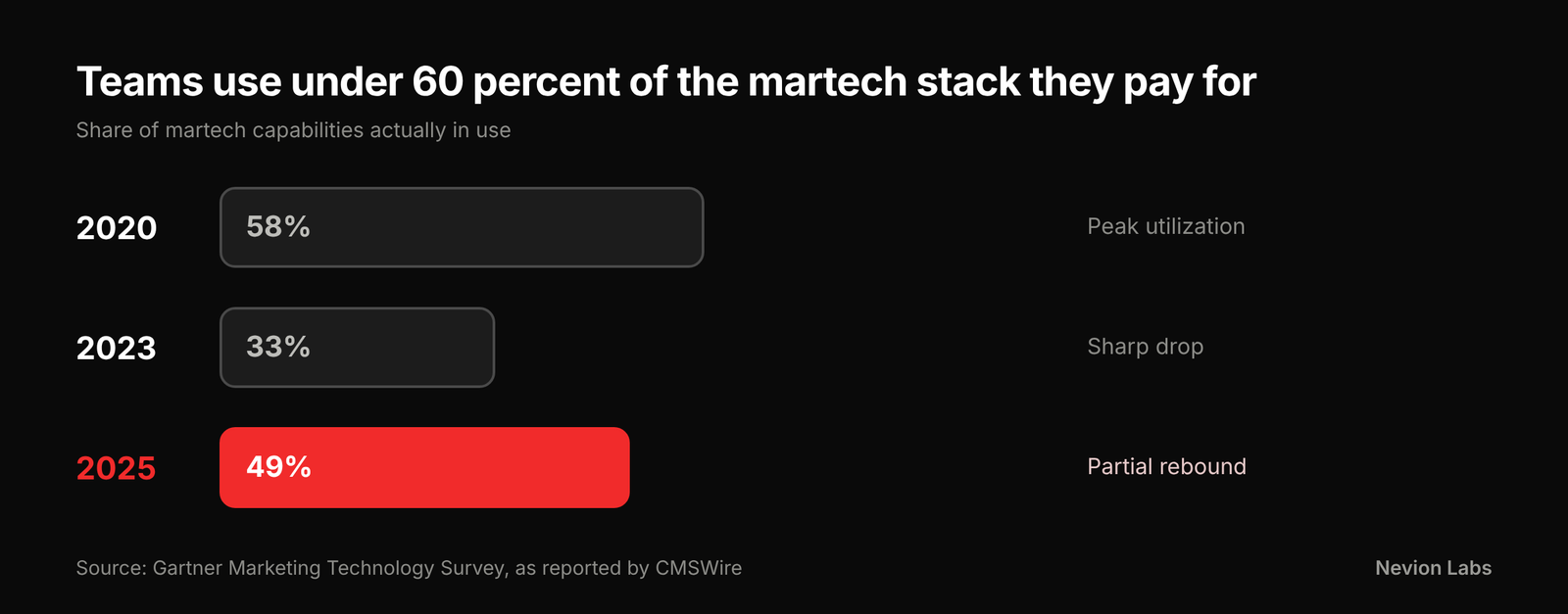
Utilization dropped sharply between 2020 and 2023 and has only partly recovered since.
This guide is for marketing leaders, founders and operations teams who want to fix that. It explains what a modern MarTech stack is made of, why stacks fail, and how to build or repair one in a sequence that works. We draw on what we see at Nevion Labs, where we spend most of our time connecting CRM, automation, tracking and analytics so that leads, data and revenue move through one clean system.
If you only remember one idea from this article, make it this: a stack is a system of data flows, not a shopping list of tools.
What MarTech is, and where the market stands today
MarTech (marketing technology) is the set of software that a company uses to attract, convert, retain and measure customers. It covers everything from the CRM and email platform to analytics, tag management, ad platforms, personalization and, increasingly, AI agents.
The category is enormous. The 2026 Marketing Technology Landscape from Chiefmartec counts 15,505 martech products, up from 15,384 a year earlier. That is a net gain of only 121 products, or 0.79 percent, which the author calls effectively flat. Behind the flat total there is real churn: 1,488 products were added (down 40 percent from 2,489 the year before) while 1,367 were removed.
Two things stand out for anyone buying or running a MarTech stack.
- Growth is no longer about more tools. The landscape may have reached a plateau. The middle of the market is being squeezed between large incumbents bundling AI features and AI-native startups attacking from below, so tools you rely on may be acquired, merged or shut down.
- Old categories are waking up. According to the same analysis, mobile and web analytics grew 11.3 percent, iPaaS and data integration 8.0 percent, governance, compliance and privacy 7.1 percent, and marketing automation 5.9 percent. AI is not only creating new categories; it is making the data foundations more valuable.
The practical conclusion is that the competitive edge is not in having more software. It is in how well your tools share clean data, and how quickly you can act on it.
SOUND FAMILIAR?Leads slipping through? We set up routing and follow-up that runs on its own.See CRM & Automation →The layers of a modern MarTech stack
A modern MarTech stack is easiest to understand as four layers of data flow, with governance applying to all of them and AI sitting on top. The data foundation in the middle matters most, because every other layer reads from it or writes to it.
1. Capture. This is where data enters: website and landing pages, forms and chat, ad platforms, event tracking through a tag manager, and offline sources such as calls and events. The job of this layer is to record who did what, from which source, and with which consent. Typical tools are a tag manager, GA4, form tools and ad-platform tags.
2. Data foundation. This is the system of record. For most small and mid-sized companies it is the CRM (for example HubSpot, Zoho CRM or Salesforce), holding contacts, accounts, opportunities, lifecycle stages and source data. Larger teams add a data warehouse or a customer data platform to unify product, billing and advertising data. Identity (matching one person across touchpoints) and consent records live here.
3. Engagement. Marketing automation and email platforms, lead routing, scoring, nurture programs and the handoff to sales. This layer acts on the data in the foundation. It should read clean fields and write activity back, so sales sees the full history of a contact.
4. Measurement. Analytics, attribution and dashboards. This layer answers the revenue questions you defined at the start. It is reliable only when the CRM stores source data at the moment a lead is created, rather than depending on browser-side analytics alone.
Governance (across all layers). A data dictionary, naming conventions, consent rules, access control and a regular review.
AI (on top). Assistants and agents that read from the layers below to draft content, answer service questions or analyze results. Their output is only as good as the data they can reach.
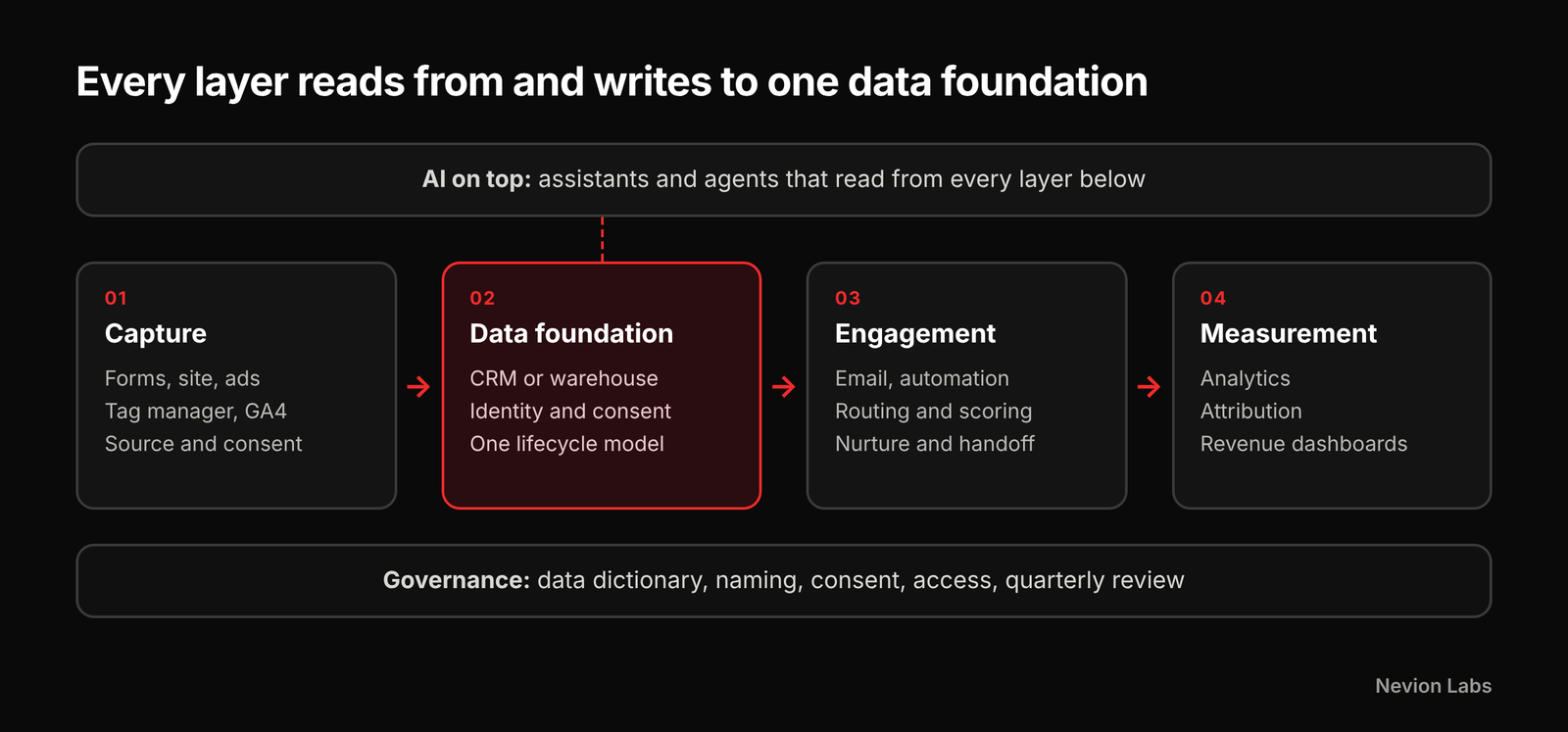
Read it left to right: data is captured, stored in the foundation, acted on, then measured.
Why most MarTech stacks underperform
A MarTech stack rarely fails because a single tool is bad. They fail because of how they were assembled and how they are run. Five patterns show up again and again.
1. The MarTech stack grew by accretion, not design. Different managers bought different tools in different years, each to solve a local problem. CMSWire’s analysis notes that the martech catalog has grown roughly 100-fold since 2011, while a team’s capacity to onboard and operate tools has grown only linearly. The result is overlap: two lead-capture tools, three analytics scripts, and no clear owner for any of them.
2. Tools are connected, but the data is not. Integration is the most common complaint. In MarTech’s 2025 State of Your Stack survey, 65.7 percent of organizations named data integration as their top stack-management challenge (figure as reported by CMSWire). A connector that moves a contact record is not the same as a shared definition of what a lead, an opportunity or a customer is.
3. Nobody owns the data model. Fields are created ad hoc. Lifecycle stages mean one thing in the CRM and another in the email platform. UTM parameters are typed by hand and spelled five different ways. Within months, reports disagree, and trust in the numbers disappears.
4. Tracking was set up once and never audited. Tags break when a website is redesigned, a consent banner is changed or a form is rebuilt. Conversions quietly stop firing, and the team keeps optimizing against incomplete data.
5. Contracts follow seats, not usage. Renewals are based on what was contracted, not on what is used. CMSWire cites a CDP with 40 seats and about four active users. Each unused tool also adds an “integration tax” of manual reconciliation work.
Notice what these have in common. None of them is fixed by buying another platform. They are fixed by deciding what data matters, who owns it and how it flows. That is the focus of the next section.
A seven-step framework to build or fix a MarTech stack
The order matters. Teams that start with tool selection usually end up rebuilding later. This sequence starts with the questions the business needs answered and works down to the tools.
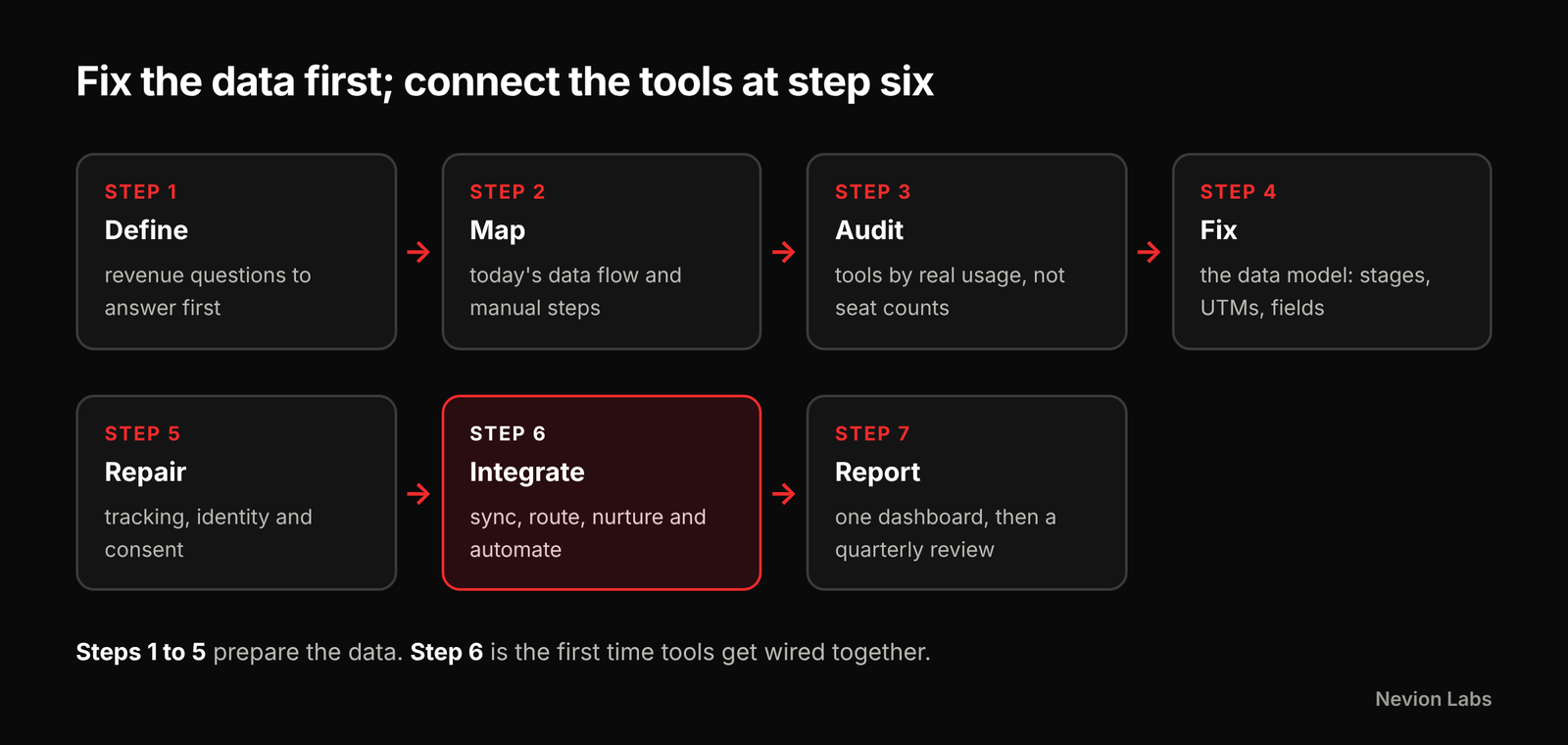
The seven steps to build a MarTech stack, one by one:
- Define the revenue questions first. Write down five to eight questions the stack must answer, such as: which channels produce qualified pipeline, how long does a lead take to convert, and where do we lose them? Every field, event and report must trace back to one of these. Anything that does not is a candidate to drop.
- Map the data flow as it exists today. Draw how a lead moves from first touch to closed deal: the form, the tag manager, the CRM, the automation platform, the sales team and the reporting layer. Mark every manual step, spreadsheet and place where data is re-typed. This map usually reveals the real problem within an hour.
- Audit tools by actual usage. Use login and feature-usage data, not seat counts. Score each tool on four factors: utilization, overlap with tools you keep, data dependency and switching cost. Before cutting a tool, trace its data. A low-usage tool may be the only link between two systems, or the system of record for consent and suppression lists.
- Fix the data model. Agree on lifecycle stages (subscriber, lead, marketing qualified, sales qualified, opportunity, customer), a single owner for each, and one naming convention for UTMs, campaigns and fields. Document it in a short, shared data dictionary.
- Repair tracking and identity. Define a small set of conversion events, implement them through a tag manager, and make sure source and campaign data are written into the CRM at the moment a lead is created. Review consent handling at the same time (see the next section).
- Integrate and automate. Only now connect the systems. Sync the CRM and automation platform both ways (if you are still choosing a tool, see our comparison of n8n, Zapier and Make), set lead-routing and follow-up rules with clear response-time targets, and build the first nurture and re-engagement flows on top of clean data.
- Report, then govern. Build one dashboard that answers the questions from step 1. Then set a quarterly review: re-check usage, tracking health and data quality. A MarTech stack bloats again without a recurring cadence.
A useful test for any MarTech stack: can a new team member trace any closed deal back to its first marketing touch in under five minutes? If yes, the stack works. If not, return to step 2.
Tracking, attribution and consent in a cookie-limited world
Measurement is where most stacks quietly leak value. Browsers restrict third-party cookies, ad blockers remove scripts, and privacy rules require consent before many tags may run. A stack that relies only on browser-side tags will under-report, and under-reporting leads to bad budget decisions.
Consent Mode. Google’s Consent Mode v2 added two signals, ad_user_data and ad_personalization, to the original consent settings. It has two implementations:
- Basic: Google tags are blocked until the visitor accepts cookies. No data is sent to Google for visitors who decline, so they add nothing to modeling.
- Advanced: Tags load right away and change behavior based on consent. For visitors who decline, they send cookieless pings with anonymized signals such as page and conversion events, and no cookie IDs. Google can then model part of the missing conversions.
According to a practitioner guide from Dataslayer, conversion modeling needs Advanced mode, at least 700 ad clicks over seven days per country and domain pair, and a reasonable consent rate (typically 20 percent or higher). The same guide cites an average cookie acceptance rate of 31 percent, which shows how much data depends on the banner design. Treat any quoted uplift percentages from vendors as unverified until you measure them in your own account.
Server-side tagging. Instead of every tag firing in the visitor’s browser, events go first to a server you control, which then forwards them to analytics and ad platforms. This gives you more control over what data leaves your site, can reduce loss from ad blockers, and makes it easier to enforce consent rules in one place. It adds hosting cost and setup effort, so it pays off most for teams with meaningful paid media spend or strict privacy needs.
First-party data and the CRM as the source of truth. For a reliable MarTech stack, the most durable fix is to capture campaign source, medium and click identifiers when a form is submitted, and store them on the lead record in the CRM. Then closed revenue can be matched back to the original source, and offline conversions can be sent back to ad platforms. Browser analytics becomes one input, not the only one.
A practical attribution approach. No single model is correct. A workable setup combines three views: platform-reported results for in-channel optimization, CRM-based first-touch and last-touch reporting for pipeline and revenue, and a periodic sanity check such as a holdout test or a self-reported “how did you hear about us” field. When the three disagree, investigate the gap rather than choosing the most flattering number.
Note: consent and privacy requirements differ by country and industry. Confirm your setup with qualified legal counsel.
AI in MarTech: what is real and what is hype
AI is now present in almost every martech product, and the data shows adoption is real. In MarTech’s 2025 State of Your Stack survey, generative AI tools reached 68.6 percent adoption (as reported by CMSWire). The harder question is where AI changes results rather than just speeding up tasks.
Martech analyst Scott Brinker, in a CMSWire overview of 2026 trends, makes a useful distinction. Most 2025 gains from AI were gains in speed, which competitors can buy too. He warns that if all you get from AI is lower unit cost, you leave most of the value on the table. Teams that pull ahead reinvest the saved time in more experiments and more relevant customer journeys.
Here is a practical split of where AI helps today and where to be careful.
Where it is working
- Content production support. Brinker names content production agents as the top internal use case. Drafting, repurposing and variant testing are the clearest wins, as long as a person edits and approves the output.
- Customer service. Many service agents can resolve over 60 percent of queries when they are grounded in a good knowledge base and customer data, according to the same source (no exact figure is given).
- Analysis and reporting. Summarizing campaign performance, spotting anomalies in tracking and drafting first-pass insights save analyst time.
Where to keep a human in the loop
- Outbound sales messaging and fully autonomous campaign orchestration.
- Anything involving compliance, pricing, claims or brand reputation.
The foundation matters more than the model. AI agents are only as good as the data they can reach. An agent that reads inconsistent lifecycle stages, duplicate contacts and missing source data will produce confident but wrong output. The Chiefmartec landscape analysis makes the same point: the quality of an on-site AI experience depends less on the model alone than on what sits underneath it. This is why integration, governance and analytics categories are growing, and why the plumbing work in this guide comes before any AI rollout.
Brinker also describes a useful way to organize a MarTech stack: a Laboratory where teams experiment with lighter governance, and a Factory that runs proven, revenue-critical programs under tighter controls. New AI use cases start in the lab, and only those that prove their value move to the factory.
What the right MarTech stack looks like at your size, and a 90-day roadmap
There is no universal stack. The right one depends on team size, sales motion and how much process you can realistically maintain. The table below is a starting point, based on common practice rather than a fixed rule.
| Company stage | Core stack | Priority | Common mistake |
|---|---|---|---|
| Small business (1-10 in marketing and sales) | One CRM with built-in email and forms, GA4, a tag manager | Capture every lead with its source; follow up within a day | Buying an enterprise suite before the process exists |
| Growing mid-market (10-50) | CRM plus a marketing automation platform, a tag manager, a reporting layer | Clean lifecycle stages, lead routing, CRM-based attribution | Two tools doing the same job, with no data owner |
| Enterprise (50+) | CRM, automation, data warehouse, governance and consent tooling, server-side tagging | Data governance, a shared data layer, controlled experimentation | Slow change control that blocks all testing |
Whatever the size of your MarTech stack, the sequence is the same: fix the data first, then connect, then automate, then add AI.
A 90-day MarTech stack roadmap
Days 1-30: Diagnose and decide.
- Define the revenue questions and the KPIs behind them.
- Map the current data flow and list every tool, owner and cost.
- Audit tracking: which conversions fire, which do not, and what happens to consent.
- Agree on lifecycle stages and naming conventions.
Days 31-60: Repair the foundation.
- Clean and de-duplicate CRM records and fields.
- Fix tracking and pass source and campaign data into the CRM at lead creation.
- Retire or merge overlapping tools after tracing their data dependencies.
- Document the data dictionary.
Days 61-90: Connect and automate.
- Sync CRM and automation both ways, and set lead routing with response-time targets.
- Launch two or three core workflows, for example new-lead follow-up and re-engagement.
- Publish one dashboard tied to the original revenue questions.
- Schedule the first quarterly stack review.
By day 90 you should be able to answer, with data you trust, which marketing activities produce pipeline, how fast leads move and where they drop off.
Frequently asked questions
What is a MarTech stack?
It is the combination of software a company uses to attract, convert, retain and measure customers, such as a CRM, email and automation platform, analytics, tag management and advertising tools, together with the integrations that move data between them.
How many tools should a marketing team use?
There is no ideal number. The right count is the smallest set that answers your revenue questions with clean data. A useful signal is utilization: if a tool is used by a fraction of its paid seats or its features overlap with another tool, review it.
Should we choose an all-in-one suite or best-of-breed tools?
Suites reduce integration work and suit smaller teams. Best-of-breed tools offer more depth but need stronger data ownership and integration skills. A common middle path is a suite for the core (CRM and automation) with a few specialist tools connected around it.
Do we need a customer data platform (CDP) or a data warehouse?
Not at the start. A clean CRM with reliable tracking solves most problems for small and mid-sized teams. Consider a warehouse or CDP when you have multiple data sources that must be unified, such as product usage, billing and advertising, and a team that can maintain it.
Where does AI fit in?
After the data foundation. Start with low-risk uses such as content drafting, reporting and analysis, test them in a sandbox, and keep a human approving anything customer-facing or compliance-related.
How long does a MarTech stack clean-up take?
For a typical small or mid-sized business, the diagnosis and core repair work can fit inside the 90-day roadmap above. Larger organizations with several regions or systems take longer.
Conclusion
The companies that get value from MarTech are not the ones with the most tools. They are the ones whose tools share clean data, whose tracking can be trusted and whose teams review the stack on a regular schedule. Fix the plumbing first, and every channel, every automation and every AI experiment built on top of it works harder.
If you want a second pair of eyes on your MarTech stack, Nevion Labs offers a practical review of your CRM, automation and tracking setup, with a clear list of what to fix first. Book a free discovery call, or browse more practical guides in our Insights library.
About the author
Ankur Pandey is Tech Lead Engineer at Nevion Labs, a MarTech agency in Ahmedabad, India, where he works on CRM, marketing automation, tracking and analytics setups. Connect with him on LinkedIn or follow Nevion Labs.
Last updated: 30 October 2026.